St. Nicholas Day, December 6, honors a bishop of Myra in what is now Turkey about whom almost nothing is certain. His legends of secret generosity inspired centuries of gift-giving, England's medieval boy bishops, and eventually Santa Claus.
The saint behind the season
Long before Santa Claus, there was Nicholas, a bishop of Myra, a city in Lycia, a province of Asia Minor in what is now Turkey. His feast falls on December 6, the date tradition gives for his death, and both the Catholic and Eastern Orthodox churches have kept it for more than a thousand years.
He is one of the best-loved saints in Christian history, honored as a patron of sailors, children, bakers, brides and pawnbrokers, among others. Yet he is also one of the least documented.
The bishop we barely know
The Catholic Encyclopedia puts it bluntly: there is scarcely anything historically certain about him except that he was Bishop of Myra in the fourth century. Even that is not universal. History.com describes him as a monk who lived in the third century, and notes that the year of his death is uncertain. The safest summary is that he lived in the late Roman world, around the turn of the third and fourth centuries.
Tradition fills in the rest. According to legend he was imprisoned during the persecution under the emperor Diocletian and freed under Constantine, and he died on December 6 in 345 or 352. A popular story places him at the great Council of Nicaea, but his name does not appear on the old lists of bishops who attended.
His stories were gathered and written down in Greek by the writer Metaphrastes in the tenth century, long after his lifetime. In 1087 Italian merchants carried off his remains from Myra to Bari, in southern Italy, and pieces of his relics spread his fame across medieval Europe.
The legends of a secret giver
By History.com's account, within a century of his death Nicholas had become the center of a series of folk legends: calming storms at sea, giving away his wealth, even restoring murdered boys to life.
The best known is the tale of the three daughters. According to legend, a poor man could not afford dowries for his three daughters, which left them facing a desperate future. Nicholas secretly tossed a bag of gold through the man's window on three separate nights, so that each daughter could marry. Over the centuries, Franciscan Media notes, this story grew into the custom of giving gifts on his feast day.
Boy bishops in medieval England
In medieval England, St. Nicholas Day opened one of the most charming customs of the church year. In many cathedrals, monasteries, schools and even country parishes, a boy was chosen from among the choristers on December 6 and dressed in a bishop's vestments. He then presided at the church's ceremonies and services until Holy Innocents' Day, December 28, leading processions and in some places preaching a sermon.
Local practice varied. Records from Durham show that the city had two boy bishops, one from the cathedral's almonry school and one from the parish of St. Oswald, and that they officiated in late spring, during Ascension week, rather than in winter. Researchers there think the Durham custom had probably ended by about 1475.
Elsewhere the custom ran until the Reformation. It was banned under Henry VIII, returned briefly in the Catholic reign of Mary I, and disappeared again under Elizabeth I. Sources disagree about the exact year of Henry's ban, so we leave the date open. Today Salisbury and Hereford cathedrals have revived the tradition, with a chorister taking the role on the Sunday nearest December 6.
From Sinterklaas to Santa Claus
In the Netherlands the saint became Sinterklaas, pictured as a tall, white-bearded man in red bishop's robes who arrives by boat to leave gifts, or lumps of coal, for children. Stories of Sinterklaas were likely carried to the Hudson River valley by Dutch settlers.
New York writers did the rest. Washington Irving's satirical A History of New York (1809), published under the invented name Diedrich Knickerbocker, pictured St. Nicholas flying in a wagon and making a distinctive gesture to his nose, details the later Christmas poem would borrow. John Pintard, founder of the New-York Historical Society, held the city's first St. Nicholas Day celebration in 1810. The poem "A Visit from St. Nicholas," better known as "The Night Before Christmas," appeared anonymously in the Troy Sentinel in 1823 with its sleigh and reindeer. Clement Clarke Moore claimed it in 1844, though some argue Henry Livingston was the true author. Later in the century, the cartoonist Thomas Nast gave Santa his rounded figure and a home at the North Pole.
St. Nicholas Day in 2026
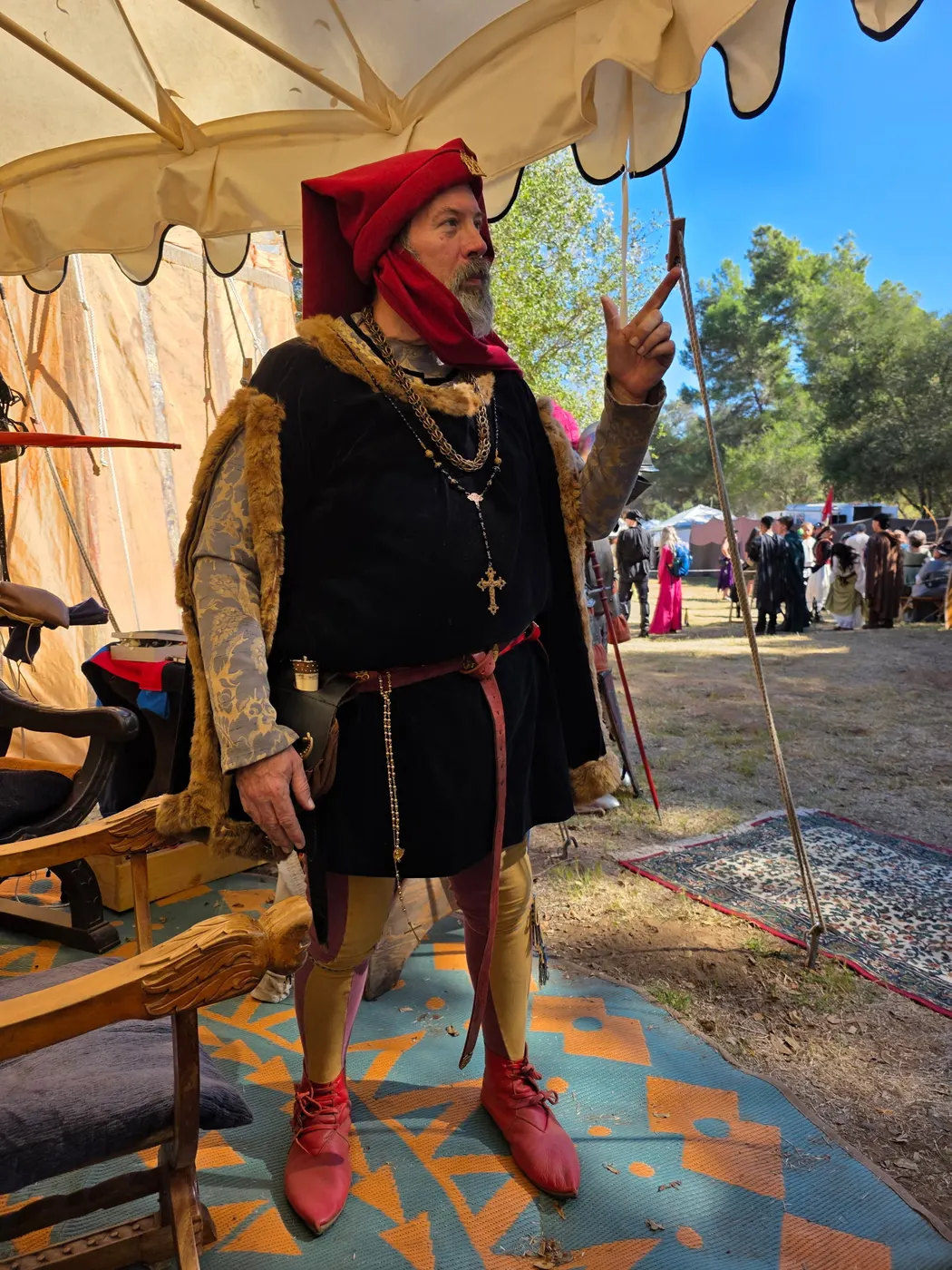
In 2026, December 6 falls on a Sunday, and it is one of the days of the Yuletide Medieval Festival. At the festival's St. Nicholas Day Feast, St. Nicholas of Myra presides alongside King Henry V, a fitting pairing for a saint whose feast medieval English churches marked with boy bishops and generosity.
Questions
When is St. Nicholas Day?
St. Nicholas Day is December 6, the traditional date of the saint's death. In 2026 it falls on a Sunday.
Was St. Nicholas a real person?
Historians generally accept that a bishop named Nicholas served at Myra, in what is now Turkey, but very little else about him is certain. Most of the well-known stories were recorded centuries after his death and are best read as legend.
What is the story of the three daughters?
According to legend, a poor man could not provide dowries for his three daughters, so Nicholas secretly threw a bag of gold through his window on three occasions. The tale became one of the roots of gift-giving on the saint's feast day.
What was a boy bishop?
In medieval England a choirboy was chosen on St. Nicholas Day to act as a mock bishop, wearing vestments and leading services and processions until Holy Innocents' Day on December 28. The custom was banned under Henry VIII, revived under Mary I and ended again under Elizabeth I. Some cathedrals have revived it today.
How did St. Nicholas become Santa Claus?
The Dutch Sinterklaas tradition likely reached colonial New York with Dutch settlers. Writers such as Washington Irving, the 1823 poem "A Visit from St. Nicholas" and the cartoons of Thomas Nast then reshaped the bishop into the sleigh-riding Santa Claus Americans know.
Sources
- St. Nicholas of Myra, Catholic Encyclopedia (New Advent)
- Boy-Bishop, Catholic Encyclopedia (New Advent)
- Saint Nicholas, Franciscan Media
- Who Was St. Nicholas?, History.com
- The boy bishop, Records of Early English Drama North-East, Durham University
- The Story Behind the Most Famous Christmas Poem of All, Columbia Magazine