The Lord of Misrule was a mock ruler appointed to run the Christmas games in English royal and noble households, colleges and the Inns of Court. His best-documented reigns are Tudor, well after 1420, and his links to Roman Saturnalia are a parallel rather than a proven pedigree.
What was the Lord of Misrule?
The Lord of Misrule was a person chosen to preside over the Christmas festivities, usually for the Twelve Days from Christmas to Twelfth Night. He organized the entertainments, ruled over the games like a clownish monarch, and stepped down when the season ended on Twelfth Night. Under different titles, such figures appeared at the royal court, in wealthy country houses, in the colleges of Oxford and Cambridge, at the Inns of Court, where London's lawyers trained, and in ordinary parishes.
The joke at the heart of the custom was inversion. For a few days, an ordinary member of the household was king, and his foolish decrees had to be obeyed in fun. It was a safety valve and a party planner rolled into one.
Saturnalia and the boy bishop: links and speculation
Writers have long compared the Lord of Misrule to the Roman Saturnalia. That festival, held in honor of the god Saturn, began on December 17 and brought days of merrymaking in which, as English Heritage notes, masters waited on their slaves and gambling was widespread. Romans also chose mock kings for the festival. The resemblance is striking, but roughly a thousand years separate the last Saturnalia from the first English Christmas kings, and no surviving record bridges the gap. A direct line of descent is speculation; the parallel is real.
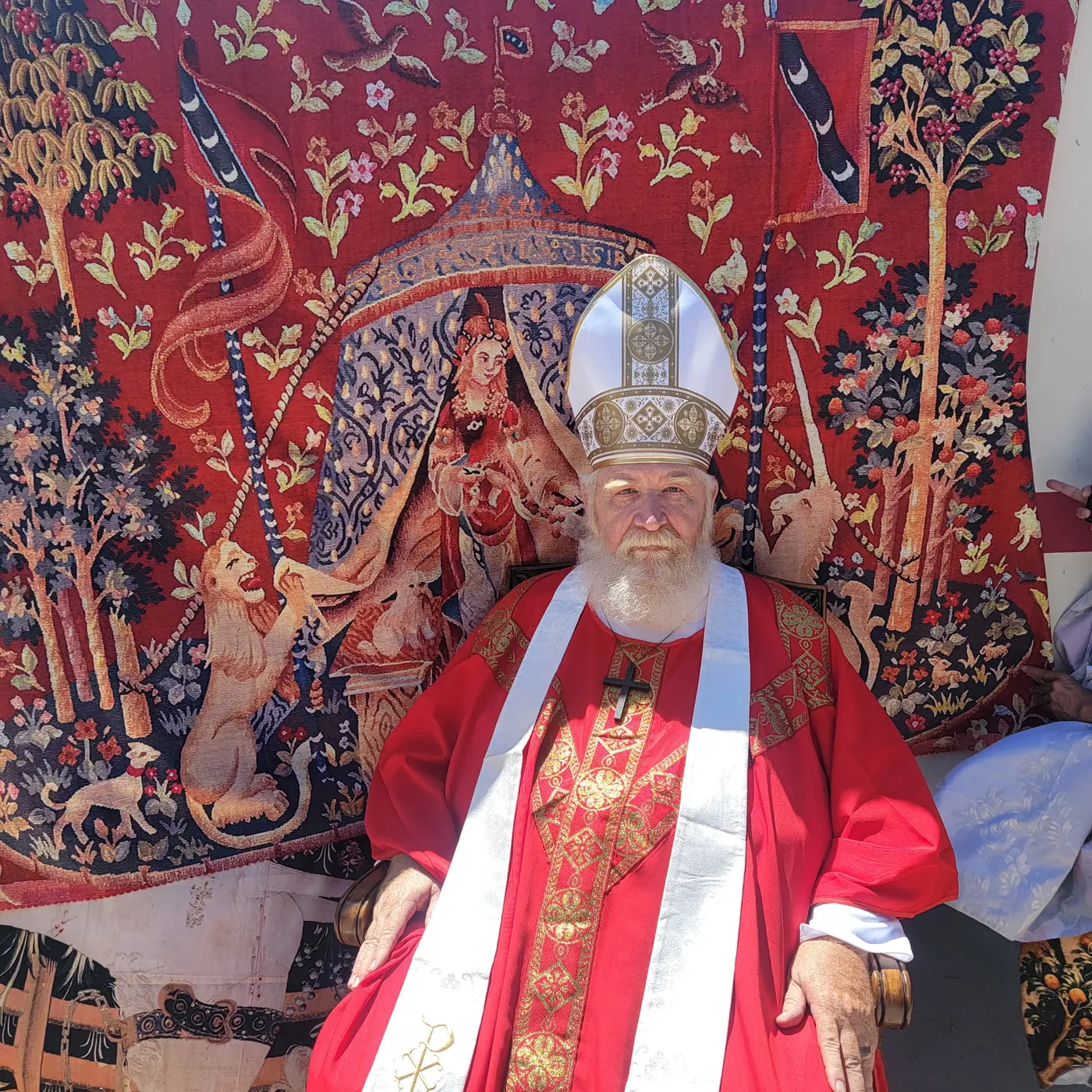
The better-documented relatives are medieval and Christian. In the church's own season of misrule, around December 26 to 28, junior clergy took over the roles of their superiors in the Feast of Fools. In 1329 Bishop John Grandisson of Exeter complained about irreverent performances on Holy Innocents' Day that ended in mud slinging. Boy bishops, choirboys chosen on St. Nicholas Day or Holy Innocents' Day, wore a miniature miter, led processions and even preached sermons. These customs show that role reversal was already woven into the English Christmas season, and English Heritage tells their story alongside the Lord of Misrule's as part of the same medieval tradition of misrule.
Before and after 1420: what the evidence shows
Some evidence predates the reign of Henry V. The medieval French court crowned Christmas bean kings, chosen by finding a bean baked into a cake, and the custom featured in a few royal Christmases of Edward II and Edward III in the 14th century. The Feast of Fools complaint at Exeter dates to 1329.
Much of the rest comes later. According to History.co.uk, the royal bean king fell out of fashion and was taken up by schools and the Oxford and Cambridge colleges, where such Christmas kings were popular in the 15th century. Tokens linked to boy bishop celebrations at Bury St. Edmunds carry a hymn verse sung to welcome Henry VI to the abbey at Christmas 1433. The title Lord of Misrule, the royal payments and the famous descriptions all date from the late 15th and 16th centuries. We have found no record of a Lord of Misrule at Henry V's own court in 1420.
The Tudor heyday
Henry VII, the first Tudor king, revived the custom with gusto. At Christmas 1489 an Abbot of Misrule impressed one observer at court, who recorded that he made much sport and did right well his office. On Christmas Eve 1491, the king paid a Lord of Misrule 5 pounds.
Henry VIII kept up lavish Christmas revels, and the colleges and Inns of Court did the same. At Lincoln's Inn in 1516, a Christmas Jack Straw caused enough damage that the culprits faced fines and expulsions. Each Inn eventually had its own Christmas prince: the Prince of the Sophie at the Inner Temple, the Prince d'Amour at the Middle Temple, the Prince of the Grange at Lincoln's Inn, and the Prince of Purpoole at Gray's Inn. Queen Elizabeth I attended Gray's Inn revels in 1565 and 1595. At St. John's College, Oxford, the Christmas lord of 1607 even had a committee of nine ministers.
The most famous royal example came under the boy king Edward VI. For Christmas 1551, George Ferrers of Lincoln's Inn was appointed lord of merry disports and paraded in a robe of purple velvet. He entertained the young king at successive Christmases and was the last royal Lord of Misrule; after Mary I took the throne in 1553, the court never appointed another.
Critics and suppression
Not everyone enjoyed the fun. The Elizabethan pamphleteer Philip Stubbes complained that the wild-heads of the parish chose a grand captain of mischief and crowned him with the title my Lord of Misrule, which shows the custom had spread well beyond palaces.
In the 17th century, Puritan reformers went much further. The 1644 Directory for Public Worship declared that festival days had no warrant in the word of God, and on June 8, 1647, Parliament passed an Ordinance for Abolishing of Festivals that banned Christmas itself across England and Wales. Christmas returned with the monarchy in 1660, but English Heritage notes that the Civil Wars had brought an end to the old festive misrule, and revelry at the Inns of Court had already declined. The Victorians revived him as a costumed character, as at a Crystal Palace Christmas in 1859.
Questions
What did the Lord of Misrule do?
He was appointed to organize and preside over Christmas entertainments such as plays, masques, games and feasts. He reigned as a comic monarch for the season and gave up his title when the festivities ended, usually on Twelfth Night.
Did the Lord of Misrule come from the Roman Saturnalia?
Possibly in spirit, but it cannot be proven. Saturnalia also had role reversal and mock kings, yet about a thousand years separate it from the first English Christmas kings, with no record linking them. Medieval church customs such as the Feast of Fools and the boy bishop are better-documented relatives.
Who was the last royal Lord of Misrule?
George Ferrers, a member of Lincoln's Inn, appointed for Christmas 1551 at the court of Edward VI. After Mary I became queen in 1553, the English court never appointed another.
Was there a Lord of Misrule in 1420?
Mock Christmas kings existed in England before 1420, such as the bean kings of Edward II and Edward III, and colleges kept similar figures in the 15th century. But the best-documented Lords of Misrule, including the royal payments and the famous Tudor examples, all come from later decades.
Sources
- Medieval Misrule and Mayhem, English Heritage (Dr. Michael Carter)
- The Lord of Misrule: The Party Prince of Christmas Past, History (history.co.uk)
- The Lord of Misrule and His Band of 'Lusty Guts', University of Leicester Library Special Collections
- Revelry in the Inns of Court, Counsel Magazine
- Christmastime in England: Prohibitions and Permissions, Library of Congress, In Custodia Legis